Showing posts with label Plan of God. Show all posts

Wednesday, April 3, 2024

The wonderful plan of God: Part 2


Thank you for reading my blog!  


The Holy Bible is an amazingly unified text that encompasses the whole plan of God to bring salvation to man through Jesus Christ and complete all of history in our Savior (Ephesians 1:10). Knowing the plan of God helps us realize the meticulous detail by which He brought us eternal life through His wisdom, knowledge, and love, for his good pleasure and praise (Ephesians 1:4-8). 


Key to this plan is: 

·       The structural elements to bring salvation. 

·       The teaching elements to allow us to recognize the Savior. 


In my last blog, we covered the plan of God from creation up to the end of the time of Abraham, roughly up to Genesis 23. Today we discuss the time of Israel and the time of the prophets.


Israel 


This chosen people was God’s fourth gracious attempt to provide a way for people of the world to seek and obey Him (please see the last blog for the first three). Israel’s history can be conveniently divided between several periods. 


Theocracy 


God desired to lead Israel as a theocracy, through his representative Moses, then Joshua, into the promised land which would be their rest, a place of peace symbolizing their final holy Kingdom under Messiah.  


Through the theocracy, God’s intention for Israel was they become a royal priesthood, a holy nation, and His unique people (Exodus 19:5-6). Further, in redeeming them He promised them a rest, safety, and a land (Deuteronomy 12:9-12). 


Unfortunately, following their redemption through the Red Sea, Israel immediately sinned and tempted God at Massa (Exodus 17:1-7Psalm 95:7-11), and they fell into judgment.  In addition, Israel failed to take the land, however, as God directed. For this reason, and continued unfaithfulness, they suffered resulting attacks from heathen countries in and around the promised land (described in the book of Judges). 


Ultimately, Israel then longed for a king like other nations so they could attain superficial stability instead of faithfully seeking God and the greater benefits of being His people (1 Samuel 8). 


The kings 


God graciously allowed a king, as the Israelites requested, through the leadership of Samuel. This change ended the theocracy. However, Israel chose Saul, the wrong King, and God ultimately provided His choice, David (1 Samuel 16), who initiated the line of Messiah (2 Samuel 7:12-16).  


God confirmed David as His choice by Davidic Covenant promising him an eternal throne, house, and kingdom (2 Samuel 7:12-16); God later upheld again these promises (Psalm 89:20 through 132:8; Rom 11:25-31). Israel under David, and under his son, Solomon, reached its height of power symbolizing the glory power, wisdom, and riches of the Messianic kingdom (Matthew 12:42). 


Key Messianic prophecies 


David was known as a person after God’s own heart (Acts 13:22; 1 Sam 13:14). Accordingly, God used David to bring forth numerous Messianic prophecies often reflecting Christ’s own affliction. Below are several of the important Davidic prophecies:  


The prophets 


After Solomon, Israel continued in sin and Israel was split into separate northern and southern kingdoms. God graciously helped Israel by revealing His will through the prophets. The age of the prophets started with Elijah and was initiated by miracles. Ultimately, important new revelation, given through the ensuing major and minor prophets (e.g., Isaiah and Hosea), warned Israel of coming judgment and urged repentance but also gave further details of the coming glorious Messianic kingdom. 


Nonetheless, Israel continued in sin and God carried away the especially sinful northern kingdom and its 10 tribes to Assyria in 722 BC, and ultimately the southern Kingdom at the beginning of the 6th century BC to Babylon for a 70-year exile. Following the exile, many Israelites in Babylon returned to the southern kingdom of Judah where they rebuilt the temple within the walls of Jerusalem. However, after Malichi, God left them in a time of prophetic silence until the coming of the Messiah 400 years later (inter-testament period). Major Messianic prophesies are given in both the major and minor prophetic books. Below are several important examples:


Thank you for joining me. God indeed has a great plan for the ages to sum all things up in Christ. join me again the next two times on this fascinating journey as we discuss the gospels and afterwards the church age and the return of our blessed Savior.


Join us again next time and share this important blog with your friends and family!


William C. Stewart, MD


Email - info@teleiosresearch.com

Website - http://teleiosresearch.com/

Facebook - https://www.facebook.com/TeleiosResearch

Instagram - https://www.instagram.com/TeleiosResearch

YouTube - https://www.youtube.com/c/TeleiosVideos/


Disclaimer - This blog and its content are provided only as information and are intended for visitors 18 and older. No content on the website should be taken as advice or recommendation to any personal or institutional situation. The views expressed are those of the author alone and not necessarily either shared or endorsed by Teleios. Both the blog and the contents are subject to change at any time without notice. Although I endeavor to ensure that the blog and the content are current and accurate, it may contain errors. I do not represent that the blog or the content is current, accurate or complete, or appropriate for your specific requirements. I do not accept any liability from any person for the blog, the content or any other information (or the use of such information) I provide. I do not have a seminary degree, but I have trained myself in the scriptures to teach and provide this information. For any specific question, I suggest you contact experts in that field and or do your own research into the scriptures.


Wednesday, March 3, 2021

Sharing Your Faith: Part 1


As Christians and recipients of God’s grace to salvation our natural response is to desire to share the gospel to other people as Christ commanded the disciples and us (Matthew 28:20Mark 16:162 Timothy 2:21-251 Peter 3:15).


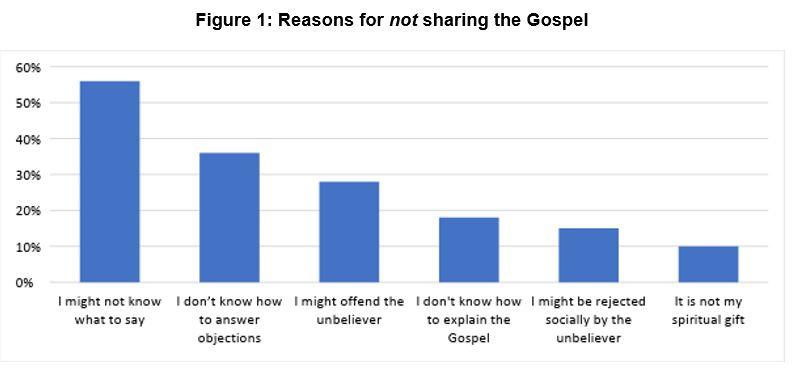
As simple as this sounds, Teleios has shown through research several issues often inhibit the gospel from being shared by many Christians (Figure 1):


Nonetheless, God graciously uses Christians to spread His gospel (Romans 10:14-16). 


In today’s blog, and the next several editions, were going to help you become a gospel sharing dynamo! Let us look first at people's view in sharing the gospel. 


Teleios research – Gospel survey 


Teleios recently evaluated how often evangelical Christians share the gospel and what makes a person fear doing so (1). We surveyed all attendees at one Sunday worship service in a midwestern evangelical church. Approximately 370 people participated. Below are some issues the survey addressed:


What is sharing the gospel? 


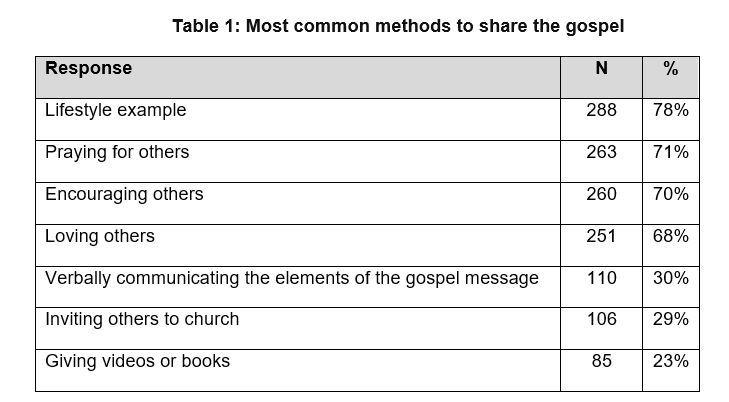
The survey also discovered what many people consider to be sharing the gospel may not necessarily include a verbal explanation! In fact, a verbal gospel message came in only number five on the list of how people say they share. Most common methods are noted in Table 1.

Verbalizing the Gospel – Biblically it is important actually to say the gospel? 


The Bible indicates in Romans 10:13-15 that someone has to actually hear the words of the gospel to understand salvation. Further, the apostle Paul in 1 Thessalonians 2:9-10 noted that although he worked day and night to live a blameless life in front of the Thessalonians, he still verbally spoke the gospel to them. In other words, non-verbal efforts, although important, will not bring somebody to belief. A non-Christian needs to hear the specific gospel message.


Do Christians fear in sharing the gospel?  


Almost all (96%) participants said they feared sharing the gospel’ but thought they should explain it more often to others (5.1/6.0 rating). Further, participants confessed to some guilt in not explaining the gospel (3.0/6.0 rating). In total, 31% indicated that they shared the plan of salvation verbally with someone once a month or more frequently. However, the fear or social pressure to explain the gospel might have caused participants to confess they exaggerate how often they actually explain the gospel (4.9/6.0 rating).


In a politically correct society where Christians often are demonized as mean, judgmental, racist and uneducated it is easy to feel ashamed and reticent to speak God’s truth. Yet if our God is the God of the Bible, He has given us His power and truth to salvation and for daily living. We have a wonderful message to give our colleagues, family and friends. We are correct and society is wrong! Therefore, we should be confident in sharing these truths in a patient and loving manner (2 Timothy 2:24-25).


Does sharing the gospel help me? 


This study also found that the personal wellbeing of the believer telling others how to become Christian was boosted. This was true also for several biblical markers for wellbeing (Table 2)! 


Table 2: Wellbeing ratings compared to verbally sharing the gospel monthly or more


Question

Share

Do not share

P-value

Content

4.8

4.5

0.007

Peace

5.0

4.5

0.0004

Joy

5.0

4.4

<0.0001

Purpose

5.3

4.8

0.0001


Why would this be? Several causes might be possible:

  • Believers may feel better after discussing the gospel realizing they are fulfilling an injunction from the Bible.

  • A Christian who explains the message of salvation may derive joy knowing they are providing good advice and helping others.

  • If a Christian does not know how to share the Gospel with someone else, they may not be able to even convince themselves of God’s faithfulness in times of personal doubt, which may hurt their own wellbeing.

  • It takes our mind off ourselves and focuses on someone else’s needs. This most likely is healthy for us and gives our mind a rest from ruminating over our own troubles.

  • It orients our goals under those of the almighty God and recognizes His purposes are greater than ours. Therefore, our personal troubles are set in proper perspective, providing a balance to our own mental health.

  • It helps build community, both in numbers and maturity, by encouraging a civil and gracious society.

  • Believers who told others about the gospel were more likely to be adherent in other areas of their Christian life including: teaching others, praying, praising God and having meaningful Christian fellowship. These extra measures of adherence, especially in associating with other believers, may have contributed to wellbeing (2,3).


Our study suggests that practicing, Bible-believing Christians generally have high ratings of wellbeing. Although Christians may fear explaining the gospel to others, those who do so show better wellbeing than those who do not.


At Teleios we believe the Bible is true instruction to salvation and healthy lives. What we offer to society is correct and true.


In contrast, what the world offers through globalism, humanism, communism, identity and statist politics cannot match the glory and the benefits from our blessed Savior. We should not recoil from the world but realize what we have is good for our family, friends and society.


Join us next time as we discuss the exact elements of the gospel and how easily it can be said to others! Thanks for joining me today and I look forward to seeing you at my next blog. 


For more on the topic see…

Jesus Film Project - We Asked 1,600+ Christians Why They Don't Share Their Faith

https://www.jesusfilm.org/blog-and-stories/asked-1600-christians-why-they-dont-share-their-faith.html 


William C. Stewart, MD


  1. https://teleiosresearch.com/gospel-survey-summary/

  2. MacIlvaine WR, Nelson LA, Stewart JA, & Stewart WC. Association of strength of community service to personal well-being. Community Ment Health J 2014;50:577-582. 

  3. MacIlvaine WR, Nelson LA, Stewart JA, & Stewart WC. Association of strength of religious adherence to quality of life measures. Complement Ther Clin Pract 2013;19:251-255. 


For questions or to view more of our research…

Email     info@teleiosresearch.com 

Website http://teleiosresearch.com/

Facebook  https://www.facebook.com/TeleiosResearch

Instagram  https://www.instagram.com/TeleiosResearch 

Youtube https://www.youtube.com/channel/UCh6wIbPgxeP0YvypwAn5-9Q


Disclaimer - This blog and its content are provided only as information. No content on the website should be taken as advice or recommendation to any personal or institutional situation. The views expressed are those of the author and not necessarily either shared or endorsed by Teleios. Both the blog and the contents are subject to change at any time without notice. Although I endeavor to ensure that the blog and the content are current and accurate, it may contain errors. I do not represent that the blog or the content is current, accurate or complete, or appropriate for your specific requirements. I do not accept any liability from any person for the blog, the content or any other information (or the use of such information) I provide. I do not have a seminary degree, but I have trained myself in the scriptures to teach and provide this information. For any specific question, I suggest you contact experts in that field and or do your own research into the scriptures.   

Wednesday, December 16, 2020

The Wonderful Plan of God: Part 1


The Holy Bible is an amazingly unified text that encompasses the whole plan of God to bring salvation to man 
through Jesus Christ and complete all of history in our Savior (Ephesians 1:10). Knowing the plan of God helps us realize the meticulous detail by which He brought us eternal life through His wisdom, knowledge and love, for his good pleasure and praise (Ephesians 1:4-8).


Key to this plan is:

  • The structural elements to bring salvation.
  • The teaching elements to allow us to recognize the Savior.


Both are detailed below in order of the scriptures. The following is an overview and not an exhaustive study.


Progression of the plan of God


Adam and Eve (Genesis 2-3) – The sin in the Garden of Eden completely corrupted the mind and physical being of man and separated him from God (Romans 5:12-14). God punished Adam and Eve for their disobedience (Genesis 3:16-19).

·      Adam is a type of Christ in that, as one man, brought death and disobedience into the world while through one man, Jesus Christ brought grace and salvation to the world (Rom. 5:15-21)

·      Key Messianic prophecy (Genesis 3:15) – God first promised a solution to the sin problem created by Adam’s fall by indicating that Eve’s seed would defeat the serpent (Satan) who caused the transgression in the garden.


Cain and Abel (Genesis 4) – Eve hoped the birth of her son, Cain (Genesis 4:1) would provide the holy man God promised in Genesis 3:15. Cain, unfortunately, proved to be a man of sin, andkilled his brother Abel because he offered a more acceptable sacrifice. Therefore, God banished Cain. From this time onwards begin the threads of two separate societies, one from Cain that hates God and embraces sin versus the people of God’s choosing who love and obey Him. Over time, the sons of God were overtaken by wicked men and the world was filled with sin (Genesis 6:1-6).


Noah (Genesis 6-9) – Because of so much sin in the world, God sent His wrath to destroyed mankind in the great flood, except for righteous Noah and his immediate family whom he graciously saved in the ark. Noah typed (foreshadowed) Christ in that:

·      He was chosen by God.

·      He built the ark out of obedience in faith.

·      The end (the beginning of the flood) came suddenly at an unknown time.

·      The chosen were saved from God’s wrath.


After Noah God gave man a third opportunity to be obedient to God.

·      Key Messianic prophecy (Genesis 9:25-27) – This verse states that the Messiah would come from the line of Shem, indicating the land of Palestine.

·      Tower of Babel (Genesis 11:1-9) – After Noah, over time people divided into 70 countries. However, in the land of Babylon the Tower of Babel was created to replace and resist God. Babylon came to represent in scripture a system of government that is anti-God and will ultimately be destroyed in the tribulation (Revelation 17 - 18). God punished man for his sin by confusing the languages to inhibit their ability to work together to resist Him.


Abraham (Genesis 11:30 through Genesis 25:11), a new plan by means of Israel – Abraham is a central figure in scripture. God chose Abraham to leave Ur of the Chaldees, which he did by faith, coming to Palestine at God’s direction. Abraham received the first major covenant from God (Genesis 12:1-3; 15:1-5). 


The Abrahamic Covenant consists of three promises which are:

·      IsaacAbraham’s son – He was significant because Abraham and his wife Sarah were too old to bear children and so believing God’s promise of a son was a test of faith which Abraham passed (Genesis 15:1-6). The provision of a son was a sign to Abraham of God’s faithfulness to complete the remaining two promises which would not be fulfilled in his lifetime.

·      A blessing to all nations – This is a promise of Messiah coming from Abraham’s seed (Galatians 3:16) through Isaac (Genesis 21:12Romans 9:7Galatians 4:28Hebrews 11:18). Isaac was a type of Christ whom God ordered Abraham to sacrifice as his only begotten son. God saved Isaac from sacrifice by providing a ram in his place (Genesis 22:1-18). It is through Isaac that the spiritual blessings of Messiah come (Genesis 21:12Romans 9:7Hebrews 11:18).

·      A founder of a great nation – This is Israel, and the promise comes through Abraham’s grandson Jacob to the ‘seed after you’ (generations following Jacob). It was confirmed by the sign of circumcision in (Genesis 17:7-14Psalm 105:6).

·      Key Messianic prophecy (Genesis 49:10) – When Jacob gave blessings to his sons he further identified the coming Messiah as a king from Judah.


The Abrahamic covenant represents in essence the cornerstone of scripture which lays out the purpose of the Bible to the Book of Revelation consisting of:

·      The plan of God to salvation through Jesus Christ and to conclude the history of the whole world in Him at His second coming.

·      The provision of Israel to provide Messiah and the fulfillment of God's promises to them at Christ’s return and the establishment of His kingdom.


We have a great God who has given us a wonderful plan for salvation and to sum up all things on the earth and in heaven for eternity in Christ (Ephesians 1:10)!


Thank you for reading my blog. Join the next time as we continue this journey on the plan of God and events following Abraham. 


Join us again next time and share this important blog with your friends and family!


William C. Stewart, MD

For questions or to view more of our research…

Email                        info@teleiosresearch.com

Website                  http://teleiosresearch.com/

Facebook               https://www.facebook.com/TeleiosResearch

Instagram              https://www.instagram.com/TeleiosResearch

Youtube                 https://www.youtube.com/channel/UCh6wIbPgxeP0YvypwAn5-9Q


Disclaimer - This blog and its content are provided only as information. No content on the website should be taken as advice or recommendation to any personal or institutional situation. The views expressed are those of the author and not necessarily either shared or endorsed by Teleios. Both the blog and the contents are subject to change at any time without notice. Although I endeavor to ensure that the blog and the content are current and accurate, it may contain errors. I do not represent that the blog or the content is current, accurate or complete, or appropriate for your specific requirements. I do not accept any liability from any person for the blog, the content or any other information (or the use of such information) I provide. I do not have a seminary degree, but I have trained myself in the scriptures to teach and provide this information. For any specific question, I suggest you contact experts in that field and or do your own research into the scriptures.