Showing posts with label fellowship. Show all posts

Thursday, March 26, 2026

Beyond Sunday Meetings: Why True Biblical Fellowship is Vital for Young Christians


In an increasingly digital world, the word “community” is thrown around constantly. But for young believers, what does it mean to truly experience biblical fellowship? Is it just grabbing coffee after a service, or is it something deeper?

Teleios Research conducted a survey of 161 participants to understand their habits and beliefs regarding fellowship. Participants are predominantly female (72%), under 35 years old (81%), from the United States (63%), and evangelical (763%).

The findings offer a powerful look at how the next generation of the Church views connection.
 
The Data: Do Young Christians Value Fellowship?

The research suggests that young adults aren’t just looking for social clubs; they are looking for spiritual depth. Here are some key results:

  • Necessity: 75% of respondents believe fellowship is necessary for the Christian life.
  • Understanding: 83% believe that Christian fellowship is not just with fellow Christians but with all members of the Trinity (Father, Son, and Holy Ghost).
  • Frequency: A small majority (52%) engage in fellowship where biblical topics are discussed at least once a week, while just over 25% either never have fellowship, or do so only a few times a year.
  • Effect: Fellowship was seen as good for them, as it brings joy (81%), serves as a good example to other believers (77%), and provides an avenue for Godly correction (76%).
  • Wellbeing: Christians who do fellowship have higher wellbeing than those who do not (P=0.005).

For full results, visit this page: Fellowship habits of young Christians.


The Definition: What Does Fellowship Mean?


While social events like coffeeshop meet-ups, church potlucks, or game nights are wonderful for building relationships, true biblical fellowship has a distinct spiritual basis and goes beyond them. 


Let’s learn them one-by-one:


  • Linguistic Root: The biblical word ‘fellowship’ is most closely expressed in the Greek by the word koinōnia (κοινωνία), and its derivatives, which mean basically ‘communion’ as well as the word metochē (μετοχή), which means ‘participation.’
  • Description: The bible describes fellowship in the most general ways:
    • It occurs only between Christians – This is because we cannot be encouraged or learn from those who do not have the Spirit or who do not understand the Christian faith (1 John 1:6-10; 2 Corinthians 6:14).
    • Do not neglect – We are not to avoid fellowship. This is because it is good for us. It is also good for other people to see God working in us (Hebrews 10:15-18; Hebrews 13:15).
    • Functional definition – In reality, the Bible does not give a lot of detail or a singular text defining ‘fellowship.’ However, in terms of function, any spiritually based interaction among Christians, as described in the Bible, might be considered fellowship (Colossians 3:12-17; Ephesians 5:15-20).
  • Importance: We don’t pursue a fellowship just because it’s a tradition; we do it because it is foundational to our growth. As Christians, we need the example, as well as the verbal encouragement and reminders of God’s word from others, to help promote our own walk with God (1 Timothy 4:12-16). Likewise, our actions and speech provide this to other believers.


The Action: How Should Christians Do Fellowship?


True biblical fellowship can occur in many settings. Regardless of the setting, biblical fellowship is framed in a lifestyle that is upstanding (1 Thessalonians 2:10) and speech that helps and encourages others (Ephesians 4:29).


But how do we do this? Here are some ideas:

  1. Know the Word. To speak truth into someone’s life, you must know the Truth. Avoid using “church jargon” and focus instead on sharing sound biblical principles that offer real hope.
  2. Be Intentional (Plan Ahead). Don’t leave spiritual conversation to chance. Before meeting a friend, think of one specific way you can encourage them. You may share a verse you’ve been studying, recount what God has been doing in your life, or prepare a thought-provoking question to ask them (Colossians 1:3-7; 1 Thessalonians 1:5-7; 1 Timothy 4:16). Pro Tip: If you don’t know what to ask, check their social media accounts and learn about them. If you are attending a gathering, then you can focus on one person.
  3. Be a Radical Listener. The Bible tells us to be “quick to listen” (James 1:9) By truly listening, you discover the specific areas where your brothers and sisters need encouragement or prayer.
  4. Control the Environment. It can be hard to have a deep spiritual conversation in a loud, crowded room. If you want deeper fellowship, create the space for it. Choose a quiet meeting place where you won’t be interrupted and where you feel comfortable discussing God’s Word. 

While church services provide a wonderful foundation for meeting others, the deepest roots of fellowship are grown through your own initiative. It takes intentionality to plan and pursue these spiritual connections, but the reward is a life sharpened by God’s encouragement and wisdom.


Don’t wait for an invitation—make authentic biblical community a non-negotiable part of your weekly rhythm.


Stay tuned! We’ll be sharing more research-backed insights soon to help you thrive in your walk with Christ.


William C. Stewart, MD


Email – info@teleiosresearch.com

Website – http://teleiosresearch.com

Facebook – https://www.facebook.com/TeleiosResearch

YouTube – https://www.youtube.com/c/TeleiosVideos

TikTok – https://www.tiktok.com/@teleiostiktok

LinkedIn – https://www.linkedin.com/company/teleiosresearch


Disclaimer – This blog and its content are provided only as information and are intended for visitors 18 and older. No content on the website should be taken as advice or recommendation to any personal or institutional situation. The views expressed are those of the author alone and not necessarily either shared or endorsed by Teleios. Both the blog and the contents are subject to change at any time without notice. Although I endeavor to ensure that the blog and the content are current and accurate, it may contain errors. I do not represent that the blog or the content is current, accurate or complete, or appropriate for your specific requirements. I do not accept any liability from any person for the blog, the content or any other information (or the use of such information) I provide. I do not have a seminary degree, but I have trained myself in the scriptures to teach and provide this information. For any specific question, I suggest you contact experts in that field and/or do your own research into the scriptures.


Wednesday, January 15, 2025

Good Characteristics to Enhance Wellbeing


Welcome back! Thanks for visiting my blog today!


We are exploring together what the Bible says about wellbeing. Otherwise, how can you live a more satisfied, fulfilling life? Recently, we have been discussing the 5 scriptural tools to maturity (Acts 2:42,47) as a means to build robust Biblically based wellbeing into our lives! Today, with these tools in hand we discuss the results of the process!


The fruits of maturing in Christ are multiple and are mentioned throughout the New Testament. Let's begin by focusing on four Bible-based characteristics shown to be beneficial for wellbeing in the medical literature (forgiveness, gratitude, hope, and empathy)To accomplish our goal, we reviewed clinical studies covering these four characteristics in patients from 1966 to present. We included 63 articles in the review. Read the full date here https://teleiosresearch.com/the-effect-of-religion-on-individual-wellbeing/.


All four measures evaluated in our study were shown to improve wellbeing, from pre-adolescents to older adults. Further, these measures were associated more specifically with improved social relationships and physical health as well as reduced delinquent behavior.


Although our review focused on the effect of four specific measures on the individuals themselves and not on the recipient, we might speculate that any increase in wellbeing among the evaluated individuals could transmit a greater sense of wellbeing to others.


The source of the four evaluated parameters also was evaluated and only two primary sources were found!  First, forgiveness, gratitude and empathy could be taught, at least to some degree, through classes or a training module. Hope has not been evaluated in a training module to our knowledge.


Second, a person’s religious faith, or their involvement in a community of believers, appeared positively associated with all four evaluated measures. How the measure was developed through religion was not completely clear. We might speculate that forgiveness, gratitude, hope, and empathy were produced through knowledge from the religion’s scriptures, through self-learning or sermons, or through interaction with the faith community. Importantly, almost all articles evaluated in our review were from traditionally Christian countries.


Our review suggests that forgiveness, gratitude, hope and empathy may improve general wellbeing, pro-social and positive relational behavior and demonstrate positive health effects. These four measures may be derived from religious instruction and through a faith community. 


I hope you come back next Wednesday for another important blog!


William C. Stewart, MD


Email – info@teleiosresearch.com

Website – http://teleiosresearch.com/

Facebook – https://www.facebook.com/TeleiosResearch

Instagram – https://www.instagram.com/TeleiosResearch

YouTube – https://www.youtube.com/c/TeleiosVideos/


Disclaimer – This blog and its content are provided only as information and are intended for visitors 18 and older. No content on the website should be taken as advice or recommendation to any personal or institutional situation. The views expressed are those of the author alone and not necessarily either shared or endorsed by Teleios. Both the blog and the contents are subject to change at any time without notice. Although I endeavor to ensure that the blog and the content are current and accurate, it may contain errors. I do not represent that the blog or the content is current, accurate or complete, or appropriate for your specific requirements. I do not accept any liability from any person for the blog, the content or any other information (or the use of such information) I provide. I do not have a seminary degree, but I have trained myself in the scriptures to teach and provide this information. For any specific question, I suggest you contact experts in that field and or do your own research into the scriptures.


Wednesday, March 3, 2021

Sharing Your Faith: Part 1


As Christians and recipients of God’s grace to salvation our natural response is to desire to share the gospel to other people as Christ commanded the disciples and us (Matthew 28:20Mark 16:162 Timothy 2:21-251 Peter 3:15).


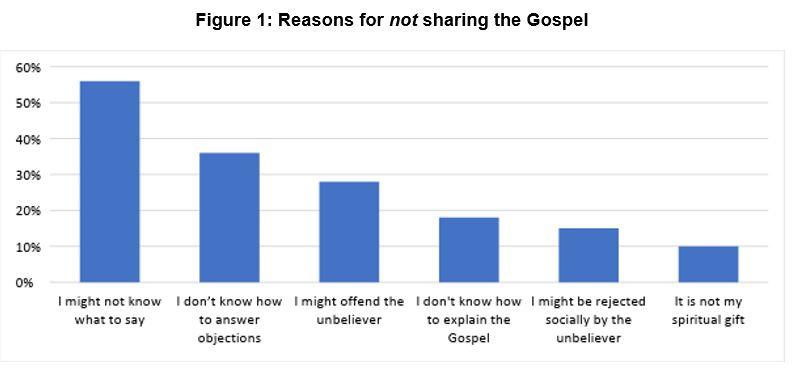
As simple as this sounds, Teleios has shown through research several issues often inhibit the gospel from being shared by many Christians (Figure 1):


Nonetheless, God graciously uses Christians to spread His gospel (Romans 10:14-16). 


In today’s blog, and the next several editions, were going to help you become a gospel sharing dynamo! Let us look first at people's view in sharing the gospel. 


Teleios research – Gospel survey 


Teleios recently evaluated how often evangelical Christians share the gospel and what makes a person fear doing so (1). We surveyed all attendees at one Sunday worship service in a midwestern evangelical church. Approximately 370 people participated. Below are some issues the survey addressed:


What is sharing the gospel? 


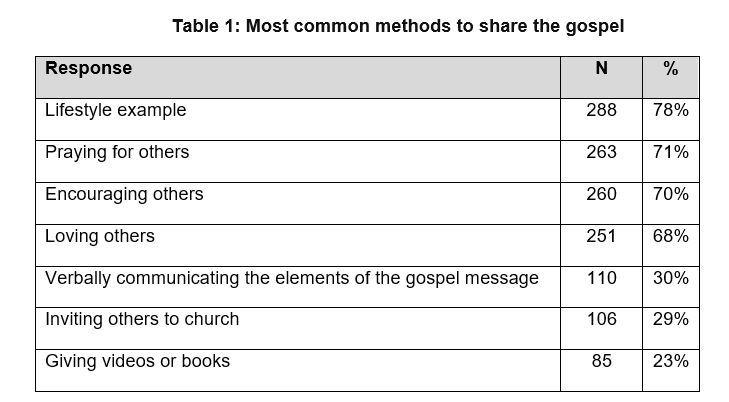
The survey also discovered what many people consider to be sharing the gospel may not necessarily include a verbal explanation! In fact, a verbal gospel message came in only number five on the list of how people say they share. Most common methods are noted in Table 1.

Verbalizing the Gospel – Biblically it is important actually to say the gospel? 


The Bible indicates in Romans 10:13-15 that someone has to actually hear the words of the gospel to understand salvation. Further, the apostle Paul in 1 Thessalonians 2:9-10 noted that although he worked day and night to live a blameless life in front of the Thessalonians, he still verbally spoke the gospel to them. In other words, non-verbal efforts, although important, will not bring somebody to belief. A non-Christian needs to hear the specific gospel message.


Do Christians fear in sharing the gospel?  


Almost all (96%) participants said they feared sharing the gospel’ but thought they should explain it more often to others (5.1/6.0 rating). Further, participants confessed to some guilt in not explaining the gospel (3.0/6.0 rating). In total, 31% indicated that they shared the plan of salvation verbally with someone once a month or more frequently. However, the fear or social pressure to explain the gospel might have caused participants to confess they exaggerate how often they actually explain the gospel (4.9/6.0 rating).


In a politically correct society where Christians often are demonized as mean, judgmental, racist and uneducated it is easy to feel ashamed and reticent to speak God’s truth. Yet if our God is the God of the Bible, He has given us His power and truth to salvation and for daily living. We have a wonderful message to give our colleagues, family and friends. We are correct and society is wrong! Therefore, we should be confident in sharing these truths in a patient and loving manner (2 Timothy 2:24-25).


Does sharing the gospel help me? 


This study also found that the personal wellbeing of the believer telling others how to become Christian was boosted. This was true also for several biblical markers for wellbeing (Table 2)! 


Table 2: Wellbeing ratings compared to verbally sharing the gospel monthly or more


Question

Share

Do not share

P-value

Content

4.8

4.5

0.007

Peace

5.0

4.5

0.0004

Joy

5.0

4.4

<0.0001

Purpose

5.3

4.8

0.0001


Why would this be? Several causes might be possible:

  • Believers may feel better after discussing the gospel realizing they are fulfilling an injunction from the Bible.

  • A Christian who explains the message of salvation may derive joy knowing they are providing good advice and helping others.

  • If a Christian does not know how to share the Gospel with someone else, they may not be able to even convince themselves of God’s faithfulness in times of personal doubt, which may hurt their own wellbeing.

  • It takes our mind off ourselves and focuses on someone else’s needs. This most likely is healthy for us and gives our mind a rest from ruminating over our own troubles.

  • It orients our goals under those of the almighty God and recognizes His purposes are greater than ours. Therefore, our personal troubles are set in proper perspective, providing a balance to our own mental health.

  • It helps build community, both in numbers and maturity, by encouraging a civil and gracious society.

  • Believers who told others about the gospel were more likely to be adherent in other areas of their Christian life including: teaching others, praying, praising God and having meaningful Christian fellowship. These extra measures of adherence, especially in associating with other believers, may have contributed to wellbeing (2,3).


Our study suggests that practicing, Bible-believing Christians generally have high ratings of wellbeing. Although Christians may fear explaining the gospel to others, those who do so show better wellbeing than those who do not.


At Teleios we believe the Bible is true instruction to salvation and healthy lives. What we offer to society is correct and true.


In contrast, what the world offers through globalism, humanism, communism, identity and statist politics cannot match the glory and the benefits from our blessed Savior. We should not recoil from the world but realize what we have is good for our family, friends and society.


Join us next time as we discuss the exact elements of the gospel and how easily it can be said to others! Thanks for joining me today and I look forward to seeing you at my next blog. 


For more on the topic see…

Jesus Film Project - We Asked 1,600+ Christians Why They Don't Share Their Faith

https://www.jesusfilm.org/blog-and-stories/asked-1600-christians-why-they-dont-share-their-faith.html 


William C. Stewart, MD


  1. https://teleiosresearch.com/gospel-survey-summary/

  2. MacIlvaine WR, Nelson LA, Stewart JA, & Stewart WC. Association of strength of community service to personal well-being. Community Ment Health J 2014;50:577-582. 

  3. MacIlvaine WR, Nelson LA, Stewart JA, & Stewart WC. Association of strength of religious adherence to quality of life measures. Complement Ther Clin Pract 2013;19:251-255. 


For questions or to view more of our research…

Email     info@teleiosresearch.com 

Website http://teleiosresearch.com/

Facebook  https://www.facebook.com/TeleiosResearch

Instagram  https://www.instagram.com/TeleiosResearch 

Youtube https://www.youtube.com/channel/UCh6wIbPgxeP0YvypwAn5-9Q


Disclaimer - This blog and its content are provided only as information. No content on the website should be taken as advice or recommendation to any personal or institutional situation. The views expressed are those of the author and not necessarily either shared or endorsed by Teleios. Both the blog and the contents are subject to change at any time without notice. Although I endeavor to ensure that the blog and the content are current and accurate, it may contain errors. I do not represent that the blog or the content is current, accurate or complete, or appropriate for your specific requirements. I do not accept any liability from any person for the blog, the content or any other information (or the use of such information) I provide. I do not have a seminary degree, but I have trained myself in the scriptures to teach and provide this information. For any specific question, I suggest you contact experts in that field and or do your own research into the scriptures.   

Wednesday, February 24, 2021

Security of Salvation: Part 5


You are saved by faith alone!


Welcome back to my blog. We began several blogs ago a vital section on our security of salvation. This is a critical point to understand scripture. 


Christians have entered the gateway to a relationship with God by faith in Christ’s forgiveness for our sins by His death on the cross. Through His gracious sacrifice, God sees us without fault and completely accepted by Him (Ephesians 2:7-9; Romans 3:21-25; Romans 10:9).  


It is important to realize that as Christians we are SECURE in our relationship with God.  Why is this critical? We cannot grow in our faith and serve others well if we lack confidence that God accepts us.  


This week let us summarize by discussing a vital statement from God regarding our salvation. 


Christ alone is sufficient to bring us to salvation


God not only endorses eternal security with wonderful promises, as we’ve discussed above, but He also expresses His displeasure to those who do not believe it. This statement is supported by two main passages in Hebrews 6 and Hebrews 10. Let’s examine briefly the primary passage in Hebrews 6, which although it can be controversial, is an exciting statement to our eternal security. 


Here are the main points: 

  • The author tells the young Hebrew believers that they should be mature by now; being teachers and able to judge quickly between right and wrong (Hebrews 5:12-14). 

  • He urges them to leave the rudimentary principles of the faith dealing with issues related to their salvation (Hebrews 6:1-3). 

  • He inquired how those who were saved (have known God’s gift and enlightenment and receive the spirit [all words or events consistent with salvation]) and have believed their sins were forgiven, could have another means to salvation apart from Christ (Hebrews 6:4-5). 

  • Indeed, their insistence that some sin was not forgiven indicated they would want Jesus to return to the cross and submit to public humiliation again. This is not viewed favorably by God, as you might imagine (Hebrews 6:6). 

  • The Hebrew Christians should have recognized their salvation as evidenced by the acts that they had already done (Hebrews 6:9-10). 

  • Certainly, the wonderful security we have based in Abraham, God’s promises to him, and His confirmation by an oath, are two things that provide a sure anchor for our souls (Hebrews 6:13-20). 


Hebrews 10 also indicates that for those who are unsure of forgiveness there is no other means for salvation except by Christ. The author urges those who doubt their forgiveness to stop and progress in their faith (Hebrews 10:19, Hebrews 10:26-39). 


Certainly, we have a wonderful salvation by which Christ is sufficient to cover each and every one of our sins, past, present and future. For us to say that somehow His painful, long, suffering, humiliating and unjust death is not enough to cover all our sins is an offense to God


To review, to date we have covered now six spectacular scriptural proofs (e.g., 1 Peter 1:4-5)., beyond direct scriptural statements, of our internal security: 


In summary, apart from direct statements that we are secure, we have at least six great promises as a believer because of Christ’s redemptive work on the cross, resulting in either legal or morphological irreversible changes. These assurances indicate our secure status with God: spiritual baptism, justified as innocent, God’s possession, and adopted as His children and chosen for salvation. It is our great God that causes us to persevere, not us (1 Timothy 1:12;  Philippians 1:6; 1 Thessalonians 5:23). 


Thank you for visiting my blog today. Return next time as we continue to discover the wonderful work of God in our lives through His wise and holy scripture.  

William C. Stewart, MD


For questions or to view more of our research…

Email     info@teleiosresearch.com 

Website http://teleiosresearch.com/

Facebook  https://www.facebook.com/TeleiosResearch

Instagram  https://www.instagram.com/TeleiosResearch 

Youtube https://www.youtube.com/channel/UCh6wIbPgxeP0YvypwAn5-9Q


Disclaimer - This blog and its content are provided only as information. No content on the website should be taken as advice or recommendation to any personal or institutional situation. The views expressed are those of the author and not necessarily either shared or endorsed by Teleios. Both the blog and the contents are subject to change at any time without notice. Although I endeavor to ensure that the blog and the content are current and accurate, it may contain errors. I do not represent that the blog or the content is current, accurate or complete, or appropriate for your specific requirements. I do not accept any liability from any person for the blog, the content or any other information (or the use of such information) I provide. I do not have a seminary degree, but I have trained myself in the scriptures to teach and provide this information. For any specific question, I suggest you contact experts in that field and or do your own research into the scriptures.