
As Christians and recipients of God’s grace to salvation our natural response is to desire to share the gospel to other people as Christ commanded the disciples and us (Matthew 28:20; Mark 16:16; 2 Timothy 2:21-25; 1 Peter 3:15).
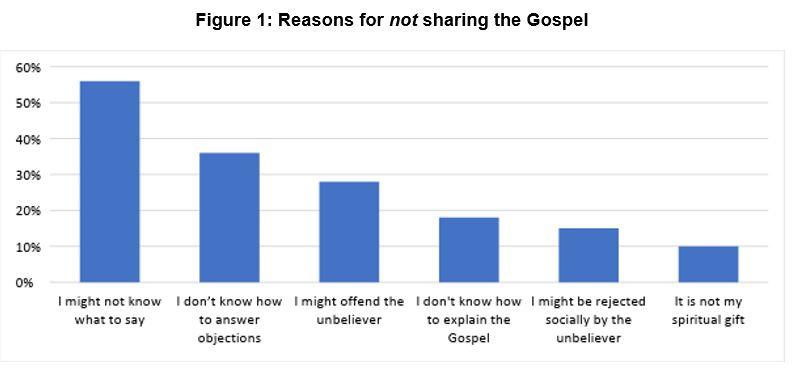
As simple as this sounds, Teleios has shown through research several issues often inhibit the gospel from being shared by many Christians (Figure 1):
Nonetheless, God graciously uses Christians to spread His gospel (Romans 10:14-16).
In today’s blog, and the next several editions, were going to help you become a gospel sharing dynamo! Let us look first at people's view in sharing the gospel.
Teleios research – Gospel survey
Teleios recently evaluated how often evangelical Christians share the gospel and what makes a person fear doing so (1). We surveyed all attendees at one Sunday worship service in a midwestern evangelical church. Approximately 370 people participated. Below are some issues the survey addressed:
What is sharing the gospel?
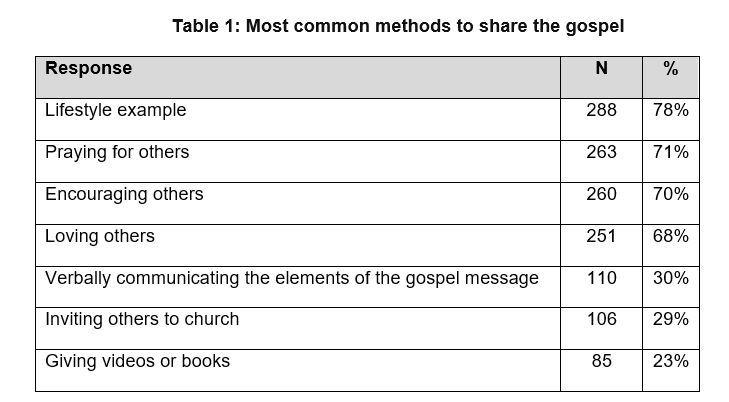
The survey also discovered what many people consider to be sharing the gospel may not necessarily include a verbal explanation! In fact, a verbal gospel message came in only number five on the list of how people say they share. Most common methods are noted in Table 1.
Verbalizing the Gospel – Biblically it is important actually to say the gospel?
The Bible indicates in Romans 10:13-15 that someone has to actually hear the words of the gospel to understand salvation. Further, the apostle Paul in 1 Thessalonians 2:9-10 noted that although he worked day and night to live a blameless life in front of the Thessalonians, he still verbally spoke the gospel to them. In other words, non-verbal efforts, although important, will not bring somebody to belief. A non-Christian needs to hear the specific gospel message.
Do Christians fear in sharing the gospel?
Almost all (96%) participants said they feared sharing the gospel’ but thought they should explain it more often to others (5.1/6.0 rating). Further, participants confessed to some guilt in not explaining the gospel (3.0/6.0 rating). In total, 31% indicated that they shared the plan of salvation verbally with someone once a month or more frequently. However, the fear or social pressure to explain the gospel might have caused participants to confess they exaggerate how often they actually explain the gospel (4.9/6.0 rating).
In a politically correct society where Christians often are demonized as mean, judgmental, racist and uneducated it is easy to feel ashamed and reticent to speak God’s truth. Yet if our God is the God of the Bible, He has given us His power and truth to salvation and for daily living. We have a wonderful message to give our colleagues, family and friends. We are correct and society is wrong! Therefore, we should be confident in sharing these truths in a patient and loving manner (2 Timothy 2:24-25).
Does sharing the gospel help me?
This study also found that the personal wellbeing of the believer telling others how to become Christian was boosted. This was true also for several biblical markers for wellbeing (Table 2)!
Table 2: Wellbeing ratings compared to verbally sharing the gospel monthly or more
Why would this be? Several causes might be possible:
Believers may feel better after discussing the gospel realizing they are fulfilling an injunction from the Bible.
A Christian who explains the message of salvation may derive joy knowing they are providing good advice and helping others.
If a Christian does not know how to share the Gospel with someone else, they may not be able to even convince themselves of God’s faithfulness in times of personal doubt, which may hurt their own wellbeing.
It takes our mind off ourselves and focuses on someone else’s needs. This most likely is healthy for us and gives our mind a rest from ruminating over our own troubles.
It orients our goals under those of the almighty God and recognizes His purposes are greater than ours. Therefore, our personal troubles are set in proper perspective, providing a balance to our own mental health.
It helps build community, both in numbers and maturity, by encouraging a civil and gracious society.
Believers who told others about the gospel were more likely to be adherent in other areas of their Christian life including: teaching others, praying, praising God and having meaningful Christian fellowship. These extra measures of adherence, especially in associating with other believers, may have contributed to wellbeing (2,3).
Our study suggests that practicing, Bible-believing Christians generally have high ratings of wellbeing. Although Christians may fear explaining the gospel to others, those who do so show better wellbeing than those who do not.
At Teleios we believe the Bible is true instruction to salvation and healthy lives. What we offer to society is correct and true.
In contrast, what the world offers through globalism, humanism, communism, identity and statist politics cannot match the glory and the benefits from our blessed Savior. We should not recoil from the world but realize what we have is good for our family, friends and society.
Join us next time as we discuss the exact elements of the gospel and how easily it can be said to others! Thanks for joining me today and I look forward to seeing you at my next blog.
For more on the topic see…
Jesus Film Project - We Asked 1,600+ Christians Why They Don't Share Their Faith
William C. Stewart, MD
For questions or to view more of our research…
Email info@teleiosresearch.com
Website http://teleiosresearch.com/
Facebook https://www.facebook.com/TeleiosResearch
Instagram https://www.instagram.com/TeleiosResearch
Youtube https://www.youtube.com/channel/UCh6wIbPgxeP0YvypwAn5-9Q
Disclaimer - This blog and its content are provided only as information. No content on the website should be taken as advice or recommendation to any personal or institutional situation. The views expressed are those of the author and not necessarily either shared or endorsed by Teleios. Both the blog and the contents are subject to change at any time without notice. Although I endeavor to ensure that the blog and the content are current and accurate, it may contain errors. I do not represent that the blog or the content is current, accurate or complete, or appropriate for your specific requirements. I do not accept any liability from any person for the blog, the content or any other information (or the use of such information) I provide. I do not have a seminary degree, but I have trained myself in the scriptures to teach and provide this information. For any specific question, I suggest you contact experts in that field and or do your own research into the scriptures.

